Monday, June 27, 2011

Walking the Woods with Kids


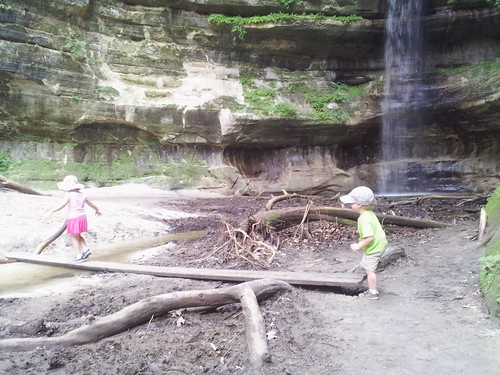
2011-06-26 17.06.36, originally uploaded by dgphilli.
I went on a hike with my husband and two young kids through Starved Rock State Park in Northern Illinois this weekend. The park is a series of canyons that were formed when the glaciers melted, forming a series of rock walls, 50' + waterfalls and sand basins from disintegrating sandstone. When I told my 4 year old daughter that we would be going on a hike to a sand mountain that they could climb, she was beyond excited. So excited, in fact, that she was so focused on getting there that she wasn't really able to enjoy the journey to our destination. Not surprising for a little kid.

In between questions of "are we there yet?", I pointed out tangled tree roots that could have been steps up the cliff, tiny shade flowers, butterflies that crossed our path, interesting moss and lichen, and anything else that I thought may interest her. Not so much. Sand mountain, please!
Tuesday, June 7, 2011

Garden Gossip: Growing Season 2011 Kickoff


I'm excited about my first entry of Garden Gossip for growing season 2011! Every year, I chronicle my little suburban garden on this blog, mostly for personal reasons so that I can remember what I did right (and wrong) the previous year. I'm not sure anyone else would find it interesting, but if you do, please read on.

To recap the last two years, I have removed about 1/3 of my backyard lawn in favor of an annual "square foot" vegetable garden and perennial planting beds for growing herbs, berries, and privacy ornamentals. The first year, I focused on making the garden beautiful in the classical French garden aesthetic with cute little useless fences that surrounded the pavers. Unfortunately, the bunnies thought the little fence was a joke and decimated most of what I grew. Same for last year, only worse - I think they told their friends. When I asked my fellow gardeners how they controlled the bunnies, they recommended a pellet gun. Ok, I don't like the rodents, but I don't want to kill them. So this year, I put up an ugly chicken wire fence. My garden isn't nearly as beautiful as last year, but so far it has kept the bunnies munching on my grass rather than my herbs. Success! Now I need to figure out what to do about the chipmunk that eats my strawberries just when they are ripe. Grr...

Friday, June 3, 2011

Want to learn more about teaching biomimicry?

Then check out the 2011 Biomimicry Education Summit in Cleveland, Ohio - June 27-29.  If you are in the Chicago region, email me for a promo code to save $150 off the registration. Click here to learn more.

Thursday, May 19, 2011

Patterns in the Forest Floor


Walking in the woods yesterday, I couldn't help but look down - mostly to make sure I didn't step on something that would throw me off balance and fall. And the forest floor is gorgeous - the random but uniform pattern of broad swatches of green and brown and the texture of the green moss intermixed with last year's dried grass is random but creates a uniform pattern. One of my cohort colleagues works for Interface carpet, and they have a line of carpet tiles called Entropy that is based on the forest floor, where nothing is uniform but the pattern that emerges is aesthetically attractive. This is especially important when dealing with construction materials. By creating a design of seemingly random patterns, tiles can be placed in any order and replaced as needed. This reduces construction waste and gives a longer life to the floor covering itself.

The Art of Systems Thinking

Creating Shelter in the Forest
We are learning about systems thinking this week during my biomimicry intensive at the Harvard Forest, so one of our exercises was to go out into the forest and create a piece of art with nature using systems thinking. The architect in me came upon a collection of downed tree limbs and I instantly wanted to build a fort. I thought about how animals create their own shelter using local dead things. Perhaps most interestingly, they follow certain rules of thumb to make sure the structure is stable, but the overall design emerges based on the characteristics of the material. So that is what I attempted to do here - create shelter using found objects. I found three live trees that I used as columns, added large felled limbs to the sides and placed medium sized limbs on top as a roof. The smallest limbs were used as a floor. Had I had more time than 45 minutes, I would have spent more time on the overall aesthetic, but it was fun to get outside and create something fun.

Monday, May 16, 2011

Genius of Place: Lichen in a New England Forest

Lichen are plants and fungus that create a mutualistic relationship greater than the sum of their parts.  What can we learn from them?


Common Greenshield Lichen.  Flavoparmelia Caperata.  Photo by Amy Coffman Phillips
Natural History
How does the lichen fit into this forest?


Walking through the forest for my first iSite in the Harvard Forest, I came upon this beautiful lichen growing on a red maple tree.  Up close, it looks like flattened lettuce or cabbage growing in these romantic formations, an example of a foliose (leaf like) lichen.  And lichen is unique because it is not one organism, but a symbiotic relationship between two organisms:  fungi and algae.  To form a lichen, the fungus either encloses the algae in fungal tissue or penetrates the algal cell wall in order to harness their photosynthetic abilities.  The fungi form the structure and then recruit algae to come live with them, and the algae benefits from the protection the fungi provide as well as their ability to capture water and nutrients.  The mutualistic relationship between these two organisms (although sometimes commensalistic or even parasitic depending on the species) is greater than the sum of its parts because it allows both organisms to survive and thrive in areas they would not be able to alone.  Their relationship creates benefits for the ecosystem as a whole as well because as rain water falls down the bark of a tree, it gathers nutrients from the lichen which feeds nitrogen and other nutrients to the soil, and then by extension, the tree and other plants.  

Vernal Pond

Vernal Pond at Harvard Forest
I am at the Harvard Forest in Petersham, Massachusetts, for my second Biomimicry session in the temperate deciduous forest and today we took a walk in the forest. To say I loved it would be an understatement, but I'm a forest lover. This is a picture of a vernal pond, or a pond that fills in the spring and then drains gradually. The Harvard School of Forestry took a sample core and was able to trace 9,000 years of history in this area from evidence that this Hemlock forest was once a Maple forest to evidence of Native American under story controlled burns. Probably most interestingly, because this is a seasonal pond and fish cannot live in it, there are no natural predators for amphibians such as frogs to lay their eggs here. Oh, and its gorgeous.