

Tuesday, October 26, 2010
Working on a Logo...


The Meaning of the Name "Liquid Triangle"
 |
| Liquid Triangle, based on the Golden Triangle |
Bruce Rawles describes a "sacred geometry" that permeates the universe as geometric templates that reveal the nature of forms in the world. These forms he says are, under it all, interconnected and inseparable. The Golden Ratio, or the Fibonnaci ratio, (1.618 to infinity) is the ratio of growth where the ratio of the larger portion to the smaller portion is the same through multiple generations. This pattern of growth is seen as the pattern for reproduction in much of nature.
- how limbs branch on trees
- how leaves radiate from a stem
- the arrangement of a pine cone
- sunflower and artichoke florets
- the family tree of the honeybees
As my calculus classes can attest, I am not a mathematician, but I find the underlying geometries of growth and reproduction in nature to be inspiring.
Amy
References:
Sacred Geometry by Bruce Rawles
Wikipedia
Tuesday, October 12, 2010
Introduction to Biomimicry

Friday, October 8, 2010
Tuesday, October 5, 2010
I got in!!!
 |
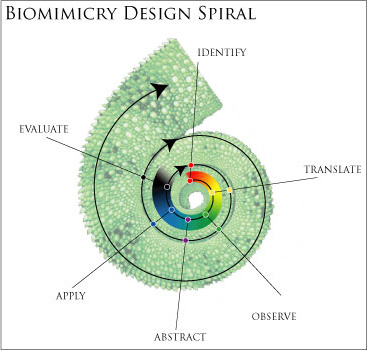
| Biomimicry Design Spiral |
Tuesday, September 28, 2010
Garden Gossip: 4th Week in September
Things are winding down in the garden lately. I planted new lettuce seeds which are now sprouting. The tomatoes are largely spent, but the dill remains vigilant even though I've cut it down to the bone once already. This weekend I will go out to harvest my last set of herbs before the frost.
Fall is a melancholy time for me. I love gardening and I love the summer, but I'm also enjoying preparing for the winter. I'm enjoying wearing sweaters and jeans after months of heat. I'm eating the greens from my CSA in various preparations, most of which are not healthy for weight loss. I'm bringing out the old slow cooker and making chili and soups. I'm getting our unfinished basement prepared for my 1yo boy and 3yo girl to be able to ride their bikes and play with their outside toys down there for the cold months. And, I'm drawing up plans for the four seasons room I hope to build this spring or next. Soon I'll start thinking about what I will grow next season.
And so the wheel of the year turns again. Welcome, Fall!


Fall is a melancholy time for me. I love gardening and I love the summer, but I'm also enjoying preparing for the winter. I'm enjoying wearing sweaters and jeans after months of heat. I'm eating the greens from my CSA in various preparations, most of which are not healthy for weight loss. I'm bringing out the old slow cooker and making chili and soups. I'm getting our unfinished basement prepared for my 1yo boy and 3yo girl to be able to ride their bikes and play with their outside toys down there for the cold months. And, I'm drawing up plans for the four seasons room I hope to build this spring or next. Soon I'll start thinking about what I will grow next season.
And so the wheel of the year turns again. Welcome, Fall!
Passively Conditioned Houses
I happened to read a fascinating article in the New York Times this weekend called "Beyond Fossil Fuels: Can We Build in a Brighter Shade of Green?" Except for one notable residential exception, most of my work as an architect has been in large scale building projects. Recently, I have been fascinated to learn as much as I can about greening single family homes for one primary reason: because I now live in one.
As anyone who owns a home will know, home improvement work is never done. Well, double that for an architect. We are always thinking of projects and changes we want to make, even to a relatively new home! This article, however, is not about something I can do to make my current home more environmentally friendly (although I do have my takeaways for renovation at the end); it's a whole new paradigm of building green from the onset.
 |
| Image copyright: Mika Grondahl and Guilbert Gates / The New York Times |
I had not heard of the Passive House Standard before reading this article, probably because there are only 13 certified in the United States in the last two years since the standard's creation, although according to the article they are prevalent in Europe. I have heard of and admired the requirements of the Living Buildings Challenge, a strict standard into which the passive home standard would fit into nicely.
The above graphic illustrates highly insulated walls (17 inches compared with the building standard 6"!) with two air barriers - one on the interior and one at the exterior. An air exchanger is combined with a heat exchanger to provide fresh air while reheating outdoor air with conditioned indoor air. Using the Passive House Planning Package as an energy model, design and construction decisions are modeled and trade-offs are made in real time. By doing this, passive homes can use up to 90% less heating and cooling energy than standard homes built to code and completely eliminate the use of fossil fuels through solar energy collection and water heating. And Habitat for Humanity is doing one in Vermont!
This is great, but how does this affect the house I live in now - a builder's special built barely to energy code? Here are my takeaways:
1 - Hire a professional to conduct a blower door test to find out where your air leaks are. When about $500 in cash frees up, I will do this. By blowing air into your home and testing the pressure it takes to do so, you will get a good idea of how tight your house is and where it is leaking (likely, the attic).
2 - If you have an unfinished attic or basement, as I do, add as much insulation as you can and combine it with an air barrier. Rigid spray foam works great as both and you avoid the problems that can sometimes be caused by a plastic vapor barrier. See Joe Lstiburek's insights - he is a brilliant and entertaining educator on all things building science.
3 - Think replacement cycle. For example:
- When your heating system wears out, replace it with an efficient version that takes in fresh air from outdoors and exchanges it with stale air from indoors.
- When your windows fail, replace them with triple paned glazing with insulated frames.
- If you need to replace your roof or wall shingles, add one or two layers of 2" rigid insulation on the outside of your studs and an air barrier.
Even if your existing home or building can't be completely passively heated, I believe that in most cases it is better to reuse what you have than to start over, as long as you leave it better than you found it.
Further Reading from a somewhat contrary, but well respected, point of view:
Passivhaus Building Science by John Straube
Further Reading on Passivhaus by John Straube
Subscribe to:
Posts (Atom)